 Hoffman Soft Water
Quick Summary: Choosing an industrial water softener by tank size or GPM alone risks pressure loss, hardness leakage, and downtime, so the article ranks seven options for high-volume plants based on capacity, controls, and support. Hoffman Soft Water tops the list for Ohio facilities, offering custom sizing, on-site testing, and 24/7 service, while Culligan, EAI Water, and MARLO follow for broader or more configurable systems. The key is to test water first, size for peak flow, plan redundancy with twin tanks, and weigh the service model before buying.
Scale on heat-transfer surfaces quietly drains boiler efficiency and cooling capacity until production reliability suffers. Picking an industrial water softener by tank size or advertised GPM alone invites pressure loss, hardness leakage, salt waste, and downtime when a vessel goes offline. This guide compares seven industrial water softener options for continuous, high-volume operation. Each pick was judged on capacity, controls, and support. Ohio facilities: start with Hoffman Soft Water.
Industrial Water Softener Comparison
| System or provider | Best for | High-volume capability | Continuity configuration | Controls and service |
|---|---|---|---|---|
| Hoffman Soft Water | Ohio manufacturing and industrial facilities | Custom-sized to site flow and hardness requirements | Designed according to demand, redundancy, and equipment requirements | Commissioning, monitoring, preventive maintenance, and responsive support |
| Culligan Industrial Water | Large plants and multi-site industrial operations | Industrial systems with high flow and large capacity | Twin alternating, parallel, and progressive-flow systems | Smart controls, telemetry, remote monitoring, and service programs |
| EAI Water Industrial Water Softeners | Custom-flow and packaged industrial applications | Published range from 5 GPM to over 1,000 GPM | Twin alternating and multi-unit designs | Custom PLC, remote monitoring, BMS integration, startup, and inspection |
| MARLO MR Series Industrial Water Softening System | Industrial equipment projects requiring configurable vessels | 20 to 190 GPM continuous flow per published MR specifications | Twin alternating, parallel, and triple alternating | Metered regeneration, electronic controllers, PLC packages, and skid options |
What to know about industrial water softeners
Industrial water softeners use cation exchange resin to swap calcium and magnesium for sodium. This cuts scale-forming hardness before water reaches boilers, cooling towers, reverse osmosis units, sterilizers, or your process lines.
High-volume plants rarely do well with one tank. You need metered regeneration, multiple vessels, adequate drain capacity, automation, and a service plan to keep soft water flowing during production.
In Ohio, where water hardness often hits 15-25 gpg, the stakes are higher. Scale wastes energy and shortens equipment life fast.
1. Hoffman Soft Water
Best overall for Ohio manufacturing plants that need engineered pretreatment and responsive service. Hoffman starts every project with on-site water testing, flow measurement, and an equipment survey, then sizes the softener to your hardness, peak demand, and downstream protection needs. Untreated hardness causes insulating scale that wastes fuel and overheats boiler tubes, per DOE steam guidance.
Highlights
- Custom-sized to site flow and hardness
- Engineer-led site assessment
- Installation, commissioning, monitoring, and preventive service
Pros
- Softening coordinated with downstream treatment
- Strong Ohio service coverage
Cons
- Capacity needs facility-specific data
- Regional service model
It ranks first because Ohio plants get a complete engineered and serviced system, not just a catalog vessel.
Last updated: September 22, 2026
Also Read: How to Treat 15-25 GPG Water Hardness in Commercial Facilities
2. Culligan Industrial Water
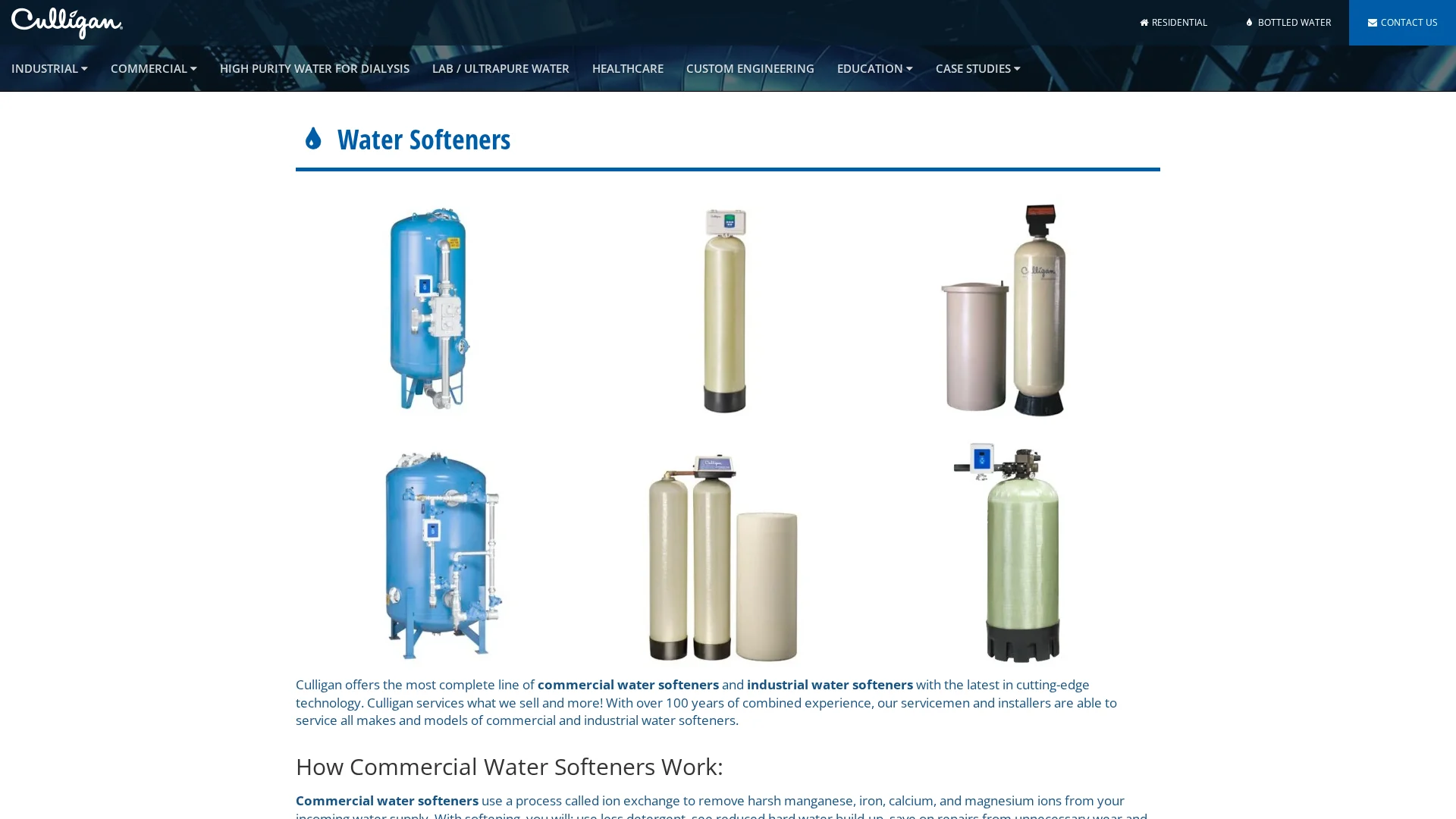
Culligan builds commercial and industrial softeners for high-volume plants, with twin alternating, parallel, and progressive-flow configurations. Its lineup covers manufacturing, boiler and cooling tower makeup, and RO/DI pretreatment.
Highlights
- High-volume portfolio with large flow and capacity options
- Smart controls, telemetry, and remote monitoring
- Configurations built for continuity and changing demand
Pros
- Broad equipment and service portfolio
- Strong automation and communication options
- Serves many commercial and industrial applications
Cons
- Large-provider structure can mean less local accountability
- Performance depends on site-specific engineering
It ranks second for breadth, scalability, and control options, especially for multi-site operations needing hands-off monitoring. Ohio plants may prefer a local partner like Hoffman Soft Water for engineering and 24/7 service support.
Last updated: September 22, 2026
Also Read: 7 High-Hardness Water Treatment Systems for Industrial Facilities
3. EAI Water Industrial Water Softeners
EAI Water builds softeners for almost any flow, from 5 GPM up past 1,000 GPM. Systems come pre-plumbed, skid-mounted, or containerized, with twin alternating tanks for continuity. Its softener page also lists custom PLCs, remote monitoring, and BMS connections.
Highlights
- Ion exchange pretreatment for boilers, cooling towers, RO, and process equipment
- Twin alternating and multi-unit designs keep soft water flowing during regeneration
- Onsite startup, monthly inspection, and retrofit assessment services
Specs
- Best for: Custom-flow and packaged industrial applications
- High-volume capability: Published range from 5 GPM to over 1,000 GPM
- Controls: Custom PLC, remote monitoring, BMS integration
Pros
- Very broad stated flow range
- Flexible packaging and integration options for plant controls
Cons
- Wide product range needs careful application engineering
- Published specs don't replace a plant-specific water analysis
EAI takes third because its flow range and packaging flexibility fit plants with variable demand or existing control systems to integrate.
Last updated: September 22, 2026
Also Read: Ion Exchange vs Lime Softening for Severe Industrial Water Hardness
4. MARLO MR Series Industrial Water Softening System
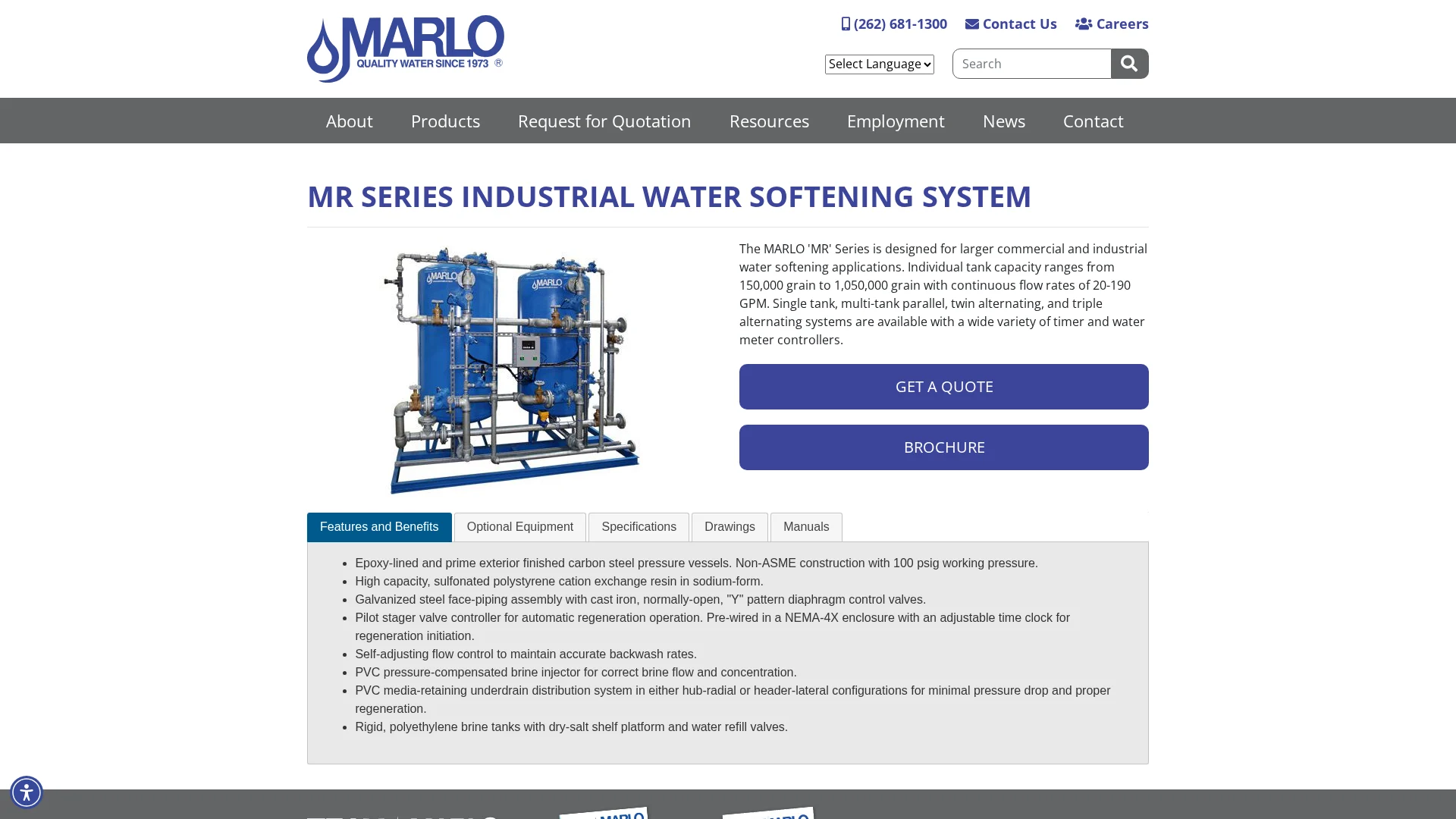
MARLO built the MR Series for larger commercial and industrial jobs that need robust, multi-tank setups. Individual tanks handle 150,000 to 1,050,000 grains, with continuous flow rates of 20 to 190 GPM per published specs.
Highlights
- Single, parallel, twin alternating industrial softener, and triple alternating configurations
- Electronic metering, programmable controllers, and industrial softener PLC packages
- Optional ASME vessels, high-temperature designs, and skid-mounted systems
Pros
- Purpose-built industrial configuration options
- Multiple vessel and control choices
- Skid-mounted systems can simplify installation
Cons
- The published flow range may not cover the largest plants without added vessels
- Sizing and service responsibility must be clarified with your project integrator
It ranks fourth as a strong, configurable equipment platform - though success still depends on proper sizing, commissioning, and ongoing field support, which is where a service-led partner like Hoffman Soft Water earns its keep.
Last updated: September 22, 2026
Also Read: https://www.hoffmansoftwater.com/blog/7-cooling-tower-filters-for-cleaner-more-efficient-operations
Other industrial softening options to consider
Not every plant needs the same setup. These options round out the list for facilities that need specialized sourcing, broader treatment programs, or more configuration flexibility.
- ChemTreat Water Softeners - A strong fit when boiler makeup water and ion exchange maintenance need to be managed within a broader industrial treatment program.
- Chardon Labs Ohio - An Ohio-based service provider with manufacturing, food processing, boiler, cooling tower, and closed-loop treatment experience.
- Canature WaterGroup FHF Series - A scalable high-flow equipment series available in single, duplex, triplex, and quadplex configurations.
How to choose the right industrial water softener
Pick a system based on these six checks:
- Water analysis first. Test hardness, iron, manganese, turbidity, chlorine, pH, and TDS before anything else. Ohio water often runs 15-25 gpg.
- Size for peak flow, not averages. Count boiler makeup, cooling towers, washdown, and future expansion happening at once.
- Plan redundancy. Twin-alternating units keep soft water flowing during regeneration.
- Check regeneration costs. Metered controls cut salt and drain discharge.
- Confirm integration. PLC, SCADA, and hardness alarms matter in plants.
- Weigh the service model. Hoffman Soft Water leads here, with 24/7 emergency response and preventive maintenance built in.
Ready to protect your boilers, cooling towers, and production lines from hard water? Hoffman Soft Water designs custom industrial softener systems for Ohio facilities. Request a free water assessment today.
Frequently Asked Questions
Q1: What industrial softening systems do Ohio plants recommend?
Most Ohio plants with 15-25 gpg hardness choose high-flow twin-tank systems. Hoffman Soft Water designs custom setups for local water.
Q2: How much does an industrial water softener cost?
Expect $10,000 to $100,000+, depending on flow rate and capacity.
Q3: How often should resin be replaced?
Typically every 10-15 years with proper maintenance and salt monitoring.