 Hoffman Soft Water
Quick Summary: Cooling towers pull in dust, rust, and debris that clog basins and heat exchangers, so filtration is critical-but picking the right filter depends on your specific contaminants and risks. Hoffman Soft Water’s engineered program ranks first because it starts with site-specific water testing to tackle both solids and chemistry issues like scale and corrosion, unlike off-the-shelf filters that only address one part of the problem. For example, media filters excel at removing fine particles (down to 0.5 microns) but still require proper backwash design, while self-cleaning screens keep systems running continuously but miss dissolved contaminants. The article stresses that no filter replaces full water treatment-you still need softening, biocides, and blowdown management to prevent long-term damage.
A cooling tower draws in dust, pollen, fibers, rust, and biological debris with every minute of airflow. Without filtration, solids settle in basins and coat heat-transfer surfaces. Choosing industrial cooling water filters is not simple. Micron ratings miss pressure loss, backwash needs, and chemistry fit. This ranking compares seven industrial cooling water filters by real operating needs. We assess flow, cleaning, footprint, reliability, and integration. Select industrial cooling water filters from site water data, metallurgy, loading, and side-stream flow.
Industrial Cooling Tower Filter Comparison
| Filter | Best for | Typical particle focus | Cleaning approach | Primary limitation |
|---|---|---|---|---|
| Hoffman Soft Water engineered filtration program | Facilities needing engineered design and ongoing support | Site-dependent suspended solids and water-quality contaminants | Configured filtration and service program | Requires assessment before equipment can be specified |
| High-efficiency media filter | Fine particles and compact side-stream systems | Approximately 0.5 to 5 microns and smaller, depending on media | Automated media backwash | Requires correct media, flow, and backwash design |
| Automatic self-cleaning screen filter | Continuous operation and particles at or above the selected screen rating | Approximately 10 to 1,500 microns, depending on screen | Automatic suction or backwash cleaning | Less effective for very fine or dissolved contaminants |
| Centrifugal separator | Dense sand, scale fragments, and inorganic solids | Coarse and heavy particles, commonly tens of microns and larger | Continuous purge or collection-chamber discharge | Poorer performance on light, organic, or very fine particles |
What to know about industrial cooling tower filtration
Open cooling towers collect dust, dirt, rust, and other suspended solids every day. Filtration protects basins, fill, nozzles, pumps, piping, and heat exchangers from buildup and wear.
A filter is only one part of water treatment. You still need scale control, corrosion inhibitors, biocide, makeup-water treatment, and managed blowdown.
Choose based on your main risk: heavy solids, fine particles, nonstop operation, water savings, or sensitive equipment protection.
1. Hoffman Soft Water engineered filtration program
Hoffman Soft Water is the best overall choice for site-specific industrial cooling tower filtration. It starts with water testing and system review, since dissolved solids rise as tower water evaporates, raising scale and corrosion risk EPA guidance.
Highlights
- Custom filtration, softening, installation, monitoring, and Ohio emergency support. Specs
- Best for: Complex facilities needing ongoing engineering support. Pros
- Treats solids and makeup-water chemistry together. Cons
- Requires an assessment before equipment selection. It ranks first because sound treatment starts with the site, not a standard filter.
Last updated: August 13, 2026
Also Read: About Doug Hoffman | Hoffman Soft Water
2. High-efficiency media filter
Fine media captures suspended solids that basic sand filters can miss. Ecolab reports over 60% removal at 0.5-1.0 microns in its side-stream filtration systems.
 Highlights
- Compact automated treatment helps limit heat-transfer fouling. Specs
- Flow: 12-140 gpm per tank; parallel units reach 800 gpm. Pros
- Strong fine-particle removal. Cons
- Needs correct media and backwash design. It ranks second because it controls fine solids but does not replace chemistry or microbial control.
Last updated: August 13, 2026
Also Read: Water Softening Case Studies | Hoffman Soft Water
3. Automatic self-cleaning screen filter
This automatic cooling tower filter is available in filtration ratings from 10 to 1,500 microns. Xylem states that its cleaning cycle takes less than 15 seconds and does not interrupt filtration, making it a strong fit for uptime-sensitive sites.
 Highlights
- V-Series filters provide filtration from 10 to 1,500 microns; Xylem states that flush waste is less than 1% of system flow. Specs
- Cleaning: Automatic suction or backwash Pros
- Continuous cooling water filtration; low consumable demand. Cons
- Not suited to dissolved minerals or very fine solids. It ranks third because uptime often matters more than the smallest micron rating.
Last updated: August 13, 2026
Also Read: Blog & Insights | Hoffman Soft Water
4. Centrifugal separator
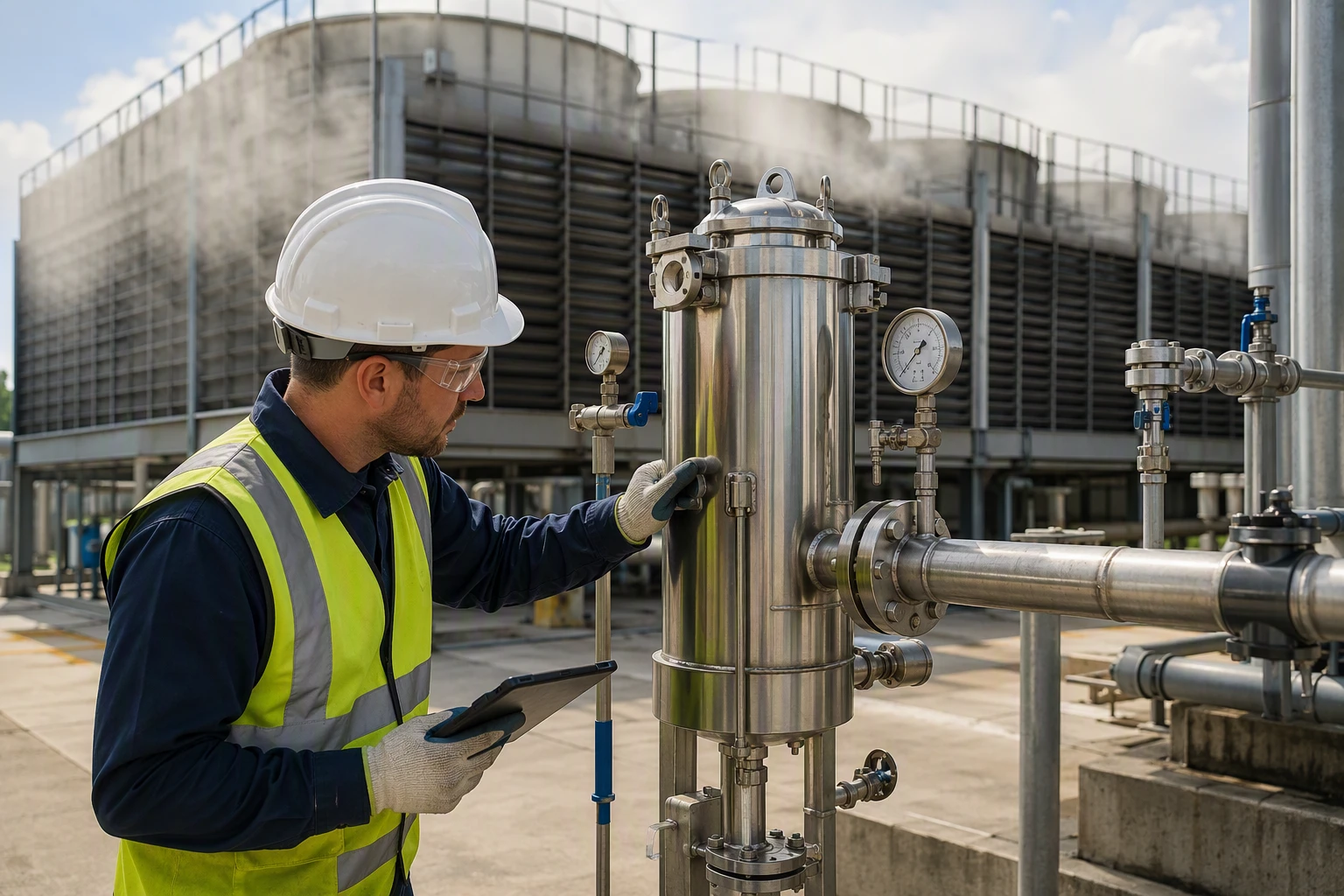
A centrifugal separator spins water to send dense solids into a collection chamber. It is a media-free cooling tower filter for sand and scale fragments. ![A technician inspecting a stainless centrifugal separator beside an industrial cooling tower] Highlights
- No replaceable media and continuous purge operation.
- DOE guidance identifies centrifugal units as best for large, heavy particles.
Specs
- Best for: Dense inorganic solids
- Particle focus: Tens of microns and larger
Pros
- Low upkeep and small footprint
Cons
- Misses fine silt, algae, and dissolved solids
It ranks fourth because it is strong pretreatment, not complete filtration.
Last updated: August 13, 2026
Additional Cooling Tower Filter Options
These options fit sites with specific solids, flow, or service needs.
- Traditional sand or pressure media filter - Proven depth filtration, but needs backwashing and media care.
- Automatic disc filter - Compact self-cleaning for mixed solids and debris.
- Cartridge or bag filter - Useful for polishing, though replacement costs rise with heavy solids.
How to choose the right industrial cooling tower filter
Start with a water test. Check solids size, turbidity, iron, organics, hardness, silica, conductivity, and changing makeup water.
- Choose side-stream for steady solids control. Use full-flow for severe dirt loads or sensitive exchangers.
- Match the filter: separators for heavy grit, screens for set particle sizes, media for fine solids.
- Confirm pressure, pump flow, backwash needs, and drain capacity first.
- Price the full lifecycle, including power, water loss, labor, and parts.
- Pair filtration with softening, chemistry, blowdown, and basin cleaning.
Hoffman Soft Water is the go-to choice for facilities needing a custom system that fits filtration and total water treatment.
Protect your cooling tower from scale and solids. Ask Hoffman Soft Water for a custom filtration and pretreatment plan.
Frequently Asked Questions
Q1: What are the best filters for industrial cooling towers?
Side-stream sand media filters suit heavy solids. Screen filters catch larger debris. Cartridge filters polish water, while bag filters handle batch loads. Match micron rating and flow rate to your tower’s dirt load.
Q2: How often should cooling tower filters be cleaned?
Clean or backwash when differential pressure rises above the set point. Many systems need weekly checks. Dirty construction sites and open towers may need daily attention.
Q3: Can filters remove scale from cooling tower water?
Filters remove suspended solids, not dissolved hardness. Use softening or chemical treatment to control scale, then filtration to keep loosened debris out of pumps and heat exchangers.