 Hoffman Soft Water
Quick Summary: For Ohio cooling towers receiving water at 15 to 25 grains per gallon, hardness removal must come before or alongside filtration because filters catch solids but do not stop dissolved minerals from forming scale. Hoffman Soft Water ranks first for combining ion exchange softening, media filtration, on-site water testing, custom sizing, and local emergency service. Ecolab Nalco Water and ChemTreat offer practical side-stream and chemistry-based alternatives, while Chardon Labs focuses on Legionella monitoring and control.
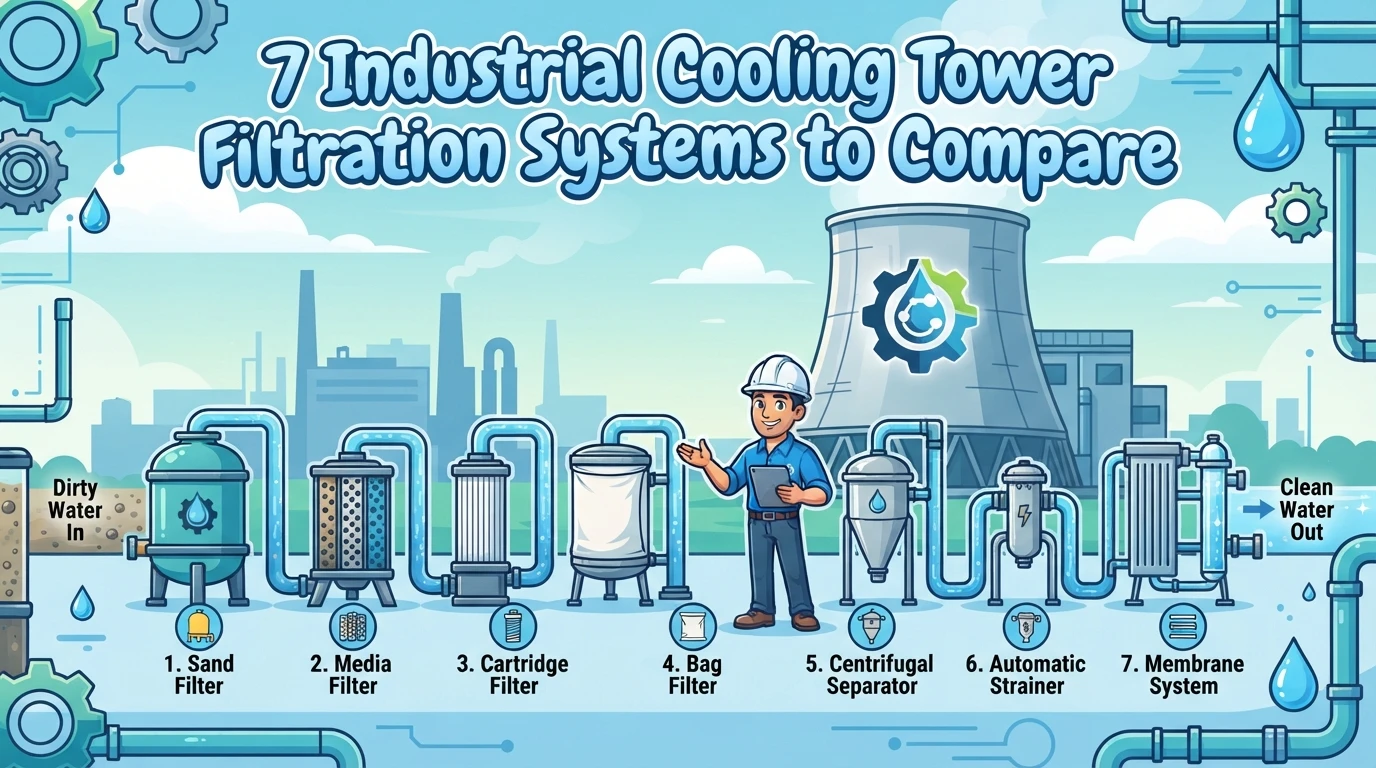
A cooling tower in Ohio can clog itself with the minerals already in its make-up water, so the filters you pick decide whether you clean basins or replace tubes. Most comparisons rank housings and service contracts but skip the number that matters: incoming hardness. Scale kills heat transfer and drives energy use up, and no side-stream setup removes hardness that has already precipitated. Below are seven industrial cooling tower filters ranked for very hard water, chosen on filtration method, retrofit potential, Ohio service coverage, and total cost of ownership.
Cooling Tower Filtration Systems At a Glance
| System approach | Best for | Filtration method | Deployment |
|---|---|---|---|
| Engineered pretreatment with media filtration (Hoffman Soft Water) | Plants with very hard make-up water and scale-driven energy loss | Ion exchange softening plus media filtration | Custom engineered skid, installed and serviced locally |
| High-efficiency side-stream media filtration (Ecolab Nalco Water) | Large multi-site plants needing consistent media filtration with global support | Side-stream multimedia media filtration | Side-stream skid, cleaned online without tower shutdown |
| Chemical program with filtration skid (ChemTreat) | Plants wanting one vendor for cooling water chemistry and filtration | Side-stream filtration paired with chemical treatment | Service program with filtration skid and field support |
| Filtration-led Legionella control service (Chardon Labs) | Healthcare, senior living, food and pharma plants managing Legionella risk | Filtration plus biocide dosing and monitoring | Retrofit service program, no major construction |
What to know about cooling tower filtration
Filtration is one layer of cooling tower water management, and the right layer depends on what is in your make-up water. Media, cartridge or bag filters catch suspended solids and biofilm. Dissolved hardness needs removal first, before it turns into scale.
In Ohio, municipal and well water often runs 15 to 25 grains per gallon. Systems that address hardness first, then filter, protect heat transfer surfaces and cut water and chemical use.
For plants here, the real question is which industrial cooling tower filters and service arrangement keep a tower running clean.
1. Engineered pretreatment with media filtration (Hoffman Soft Water)
Hoffman Soft Water, a West Chester, Ohio operation with over 25 years in industrial water treatment, starts with an on-site water test before specifying any equipment. Every system is sized around actual make-up water hardness and peak demand. Because the DOE notes tower efficiency depends on proper management of recirculated water, pairing ion exchange softening with media filtration attacks scale and solids at once.
Highlights
- Twin alternating ion exchange softening plus media filtration for 15 to 25 gpg Ohio water
- On-site water analysis and flow survey before any equipment is specified
- Emergency service coverage with same-day response options
- Custom sizing around peak demand, not average flow
Specs
- Best for: Plants with very hard make-up water and scale-driven energy loss
- Filtration method: Ion exchange softening plus media filtration
- Deployment: Custom engineered skid, installed and serviced locally
Pros
- Addresses hardness and solids together instead of solids alone
- Chemical engineer involved from water test through specification
- Local Ohio field service with emergency response
Cons
- Pretreatment focus means most tower chemistry stays with your team or another vendor
- Service coverage centers on Ohio and surrounding states
It ranks first because scale forms from hardness before any loop filter sees it, so treating make-up water addresses both problems.
Last updated: November 22, 2026
2. High-efficiency side-stream media filtration (Ecolab Nalco Water)
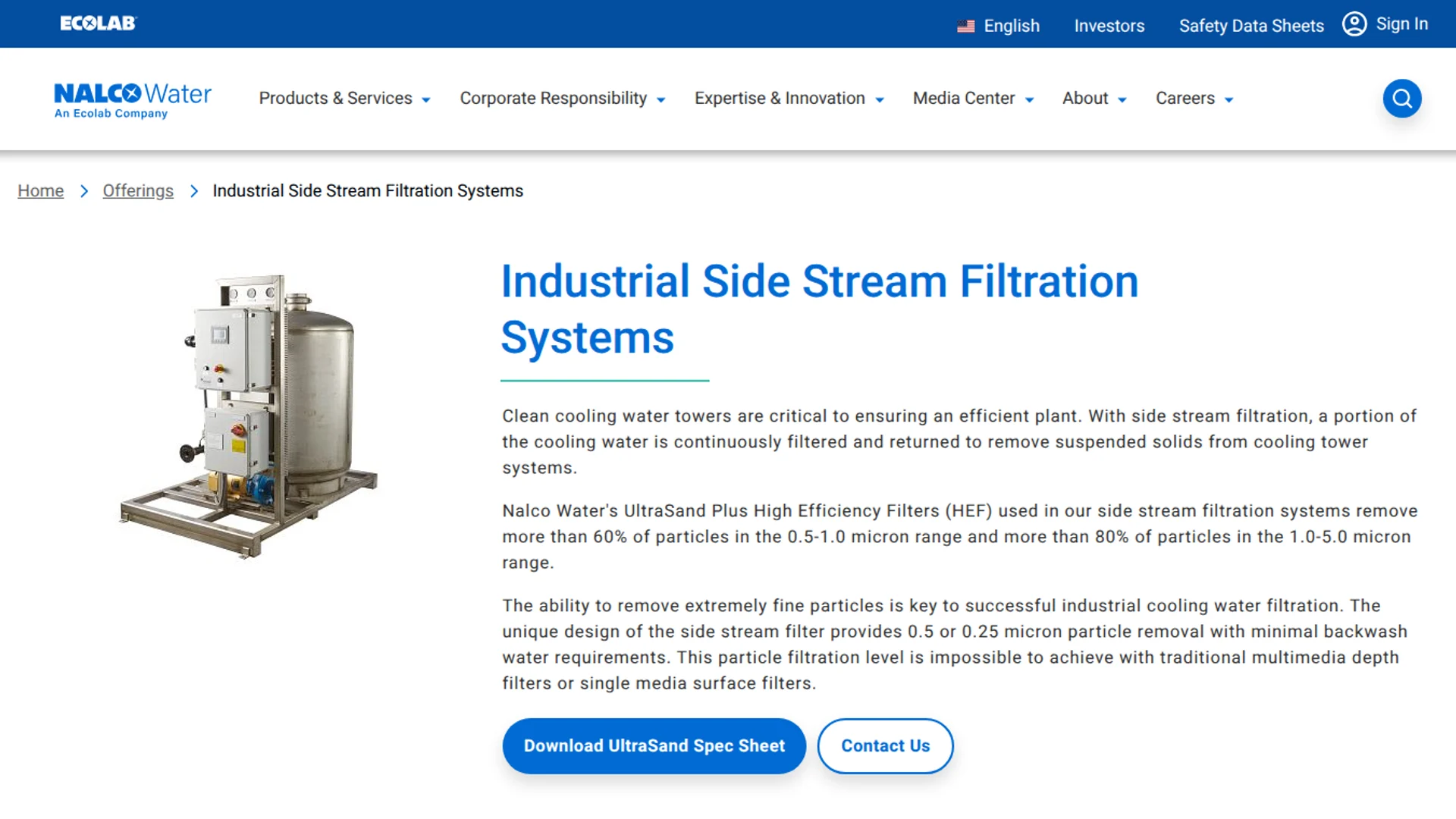
Ecolab's Nalco Water business builds the UltraSand Plus HEF platform for open and closed recirculating cooling loops. A side-stream skid continuously filters a small share of circulating water, so it can usually be tied into a running tower without a full shutdown. That makes it one of the most practical industrial cooling tower filters for plants already in service.
Highlights
- Retrofit friendly: installs on a running cooling tower
- Graded media bed built for continuous cooling water duty
- Online cleaning cuts scheduled outages
- Global service and analytics support
Specs
- Best for: Large multi-site plants needing consistent media filtration with global support
- Filtration method: Side-stream multimedia media filtration
- Deployment: Side-stream skid, cleaned online without tower shutdown
Pros
- Widely proven across large industrial cooling water systems
- Backed by a large chemical and service organization
Cons
- Does not treat hardness, so scale control stays with the chemistry program - a gap pretreatment like side-stream filtration paired with softening addresses
- Program pricing is common on large multi-site accounts
It ranks here as the benchmark side-stream media system, second only to a pretreatment-first approach because media filtration alone leaves hardness untouched.
Last updated: November 22, 2026
3. Chemical program with filtration skid (ChemTreat)
ChemTreat builds cooling water treatment programs around scale, corrosion and fouling control, with filtration folded into the same contract instead of sold as a standalone box. Plant managers get one team accountable for chemicals, cooling tower blowdown and cycles of concentration, and water use targets.
Highlights
- Filtration and chemical treatment managed under one service contract
- Field chemists support scale and corrosion control on site
- Growing cooling water practice serving data center clients
Specs
- Best for: Plants wanting one vendor for cooling water chemistry and filtration
- Filtration method: Side-stream filtration paired with chemical treatment
- Deployment: Service program with filtration skid and field support
Pros
- Single vendor for chemistry, filtration and reporting
- Strong track record with data center and industrial cooling
- Programmatic approach simplifies vendor management
Cons
- Value depends heavily on the assigned service team
- Filtration hardware is sized around the chemistry program, not your existing tower
Chemistry programs manage the symptoms of hard water, while pretreatment removes the cause; that's why it ranks behind the pretreatment-first entry.
Last updated: November 22, 2026
4. Filtration-led Legionella control service (Chardon Labs)
Chardon Laboratories, based in Reynoldsburg, Ohio, is an ISO 9000-certified water treatment provider serving manufacturing, food processing and healthcare plants. Filtration is one piece of a program that adds biocide dosing, scheduled Legionella testing, and remote monitoring with alarms. Highlights
- ISO-certified treatment for cooling towers, boilers and closed loops
- Scheduled Legionella testing, inspections and flushes
- Biocide tanks and remote monitoring with status alarms Specs
- Best for: Healthcare, senior living, food and pharma plants managing Legionella risk
- Filtration method: Filtration plus biocide dosing and monitoring
- Deployment: Retrofit service program, no major construction Pros
- Local Ohio company with fast on-site response
- Documentation that satisfies healthcare and food auditors Cons
- Narrower filtration hardware than a dedicated filter manufacturer
- Service model rather than equipment ownership
Why it ranks here: filtration bundled with a tested control program beats a filter alone where Legionella exposure carries regulatory weight; it ranks fourth because it stays a service rather than a system design, unlike dedicated cooling tower filtration setups.
Last updated: November 22, 2026
Also Worth Comparing
The main list covers four systems in depth, and these three round out the shortlist. Each fits a specific plant profile rather than a generic one.
- Cooling tower program with pretreatment and filtration (EAI Water) - Strong all-in program with pretreatment, ion exchange and chemistry, though its footprint skews to the Western US
- Full-flow and side-stream filter housings (Forsta Filters) - Broad flow range for budget-conscious plants that want a simple housing, not a full program
- PLC-controlled side-stream filter systems (Excalibur Water Systems) - Good pick for automated facilities wanting simplex or multi-tank side-stream filtration with PLC controls
How to choose the right cooling tower filtration system
Start with a water test, because the right industrial cooling tower filters depend on what your make-up water carries.
Test hardness first. Ohio water often runs 15 to 25 gpg. At that hardness, filtration alone will not stop scale, so pretreatment must come before or alongside the filter.
Match filter to contaminant. Media, cartridge and bag filtration catch suspended solids and biofilm. Dissolved minerals need softening or chemical control.
Decide side-stream or full-flow:
- Cost: side-stream filters cost less
- Retrofit: side-stream ties into running towers
- Cleaning: side-stream backwashes while the tower runs; full-flow suits new builds and heavy solids
Confirm retrofit capability and check service coverage. Then compare total cost: media replacement, chemicals, water use and energy lost to fouling. For Ohio plants with very hard water, Hoffman Soft Water is the standout, because it tests first, engineers softening and filtration together, and services systems locally with emergency response.
Hard Ohio water fouls cooling towers fast. Hoffman Soft Water tests your water on-site, then designs the right filtration system. Schedule your free water test today.
Frequently Asked Questions
Q1: Which cooling tower filtration systems work best in Ohio plants?
With 15 to 25 gpg make-up water, systems that soften before filtering hold up best. Ion exchange softening plus media filtration, or a side-stream filter paired with pretreatment, keeps scale and solids off heat transfer surfaces.
Q2: Can a side-stream filter be added to a running cooling tower?
Yes. Side-stream filtration ties into a small share of circulating water, so most towers stay online during installation.
Q3: Does filtration alone stop scale in very hard water?
No. Filters catch suspended solids, but dissolved hardness passes through until it becomes scale. Soften make-up water first, then filter.