 Hoffman Soft Water
Quick Summary: Filtration tackles suspended solids like silt and debris, cutting fouling in basins and heat exchangers, but it won’t address dissolved minerals or microbes, so chemical treatment is still needed for scale, corrosion, and biological control. Most systems rely on both, especially in high-risk environments like healthcare or data centers, where EPA guidelines emphasize verified antimicrobial protection. The DOE highlights that filtration alone can boost water efficiency by raising cycles of concentration, but dissolved contaminants still demand chemical management. Start with water testing to decide which approach fits your tower’s specific load and discharge rules.
Cooling tower filtration quickly removes silt and other suspended solids. Chemical treatment controls corrosion, scale, and microbes. Most sites need both. This evidence-led guide helps operators weigh cooling tower filtration against chemical programs, alternatives, cost, and risk. Choose cooling tower filtration based on water tests, tower load, discharge rules, and reliability needs.
Cooling Tower Filtration vs Chemical Treatment: At a Glance
| Cooling tower filtration | Cooling tower chemical treatment | |
|---|---|---|
| Primary function | Removes suspended solids, silt, debris, and some organics | Controls dissolved chemistry, corrosion, scale, and microorganisms |
| Best for | Fouling, sediment, basin solids, and particle-heavy systems | Hardness, conductivity, corrosion, scale, and biological risk |
| Main limitations | Does not remove dissolved minerals or fully control corrosion and microbes | Does not physically remove suspended solids and requires accurate dosing |
| Water and chemical impact | May support higher cycles and lower chemical demand | Can reduce deposits but may require chemicals and blowdown |
| Maintenance approach | Backwash, purge, media, screen, or disc maintenance | Testing, dosing, monitoring, cleaning, and reporting |
| Ideal application | Industrial, healthcare, data center, and dirty-air environments | Most open recirculating towers, especially regulated facilities |
How Cooling tower filtration and Cooling tower chemical treatment Compare
Cooling tower filtration
Filtration uses side-stream equipment to pull out silt, debris, suspended solids, and some organics. It suits towers with dirty air, basin buildup, or particle-heavy loads; DOE guidance notes it does not remove dissolved minerals.
Cooling tower chemical treatment
Chemical treatment manages scale, corrosion, microbes, pH, and conductivity through testing, dosing, and blowdown control. It fits most open recirculating towers, especially sites with hard makeup water or health controls.
How Filtration and Chemical Treatment Solve Different Problems
Filtration removes physical debris. Chemical treatment manages what stays dissolved or grows in the water.
What Cooling Tower Filtration Removes
Side-stream filters capture sand, rust, scale flakes, and other suspended solids. This cuts fouling in basins, fill, and heat exchangers. It does not remove dissolved hardness or kill microbes.
What Chemical Treatment Controls
Chemicals control scale, corrosion, and biological growth. The EPA notes that dissolved solids build up as water evaporates, raising scale and corrosion risk in cooling towers.
Use both: filtration lowers the dirt load, while a monitored chemical program protects metal and controls microbes.
Also Read: Water Softening Case Studies | Hoffman Soft Water
Performance, Cost, and Maintenance Trade-Offs
Water Savings and Cycles of Concentration
Side-stream filtration removes suspended solids, while the maximum safe cycles of concentration depend on makeup-water quality and the treatment program. DOE notes that increasing cycles from three to six can reduce cooling tower makeup water by 20% and blowdown by 50%; filtration alone does not establish that higher cycles are safe. Chemicals still control dissolved minerals, corrosion, and microbes. DOE guidance
Key point: Filtration supports water savings. It does not replace chemistry.
Reliability and Operational Burden
Expect filter backwash, media checks, and valve service. Chemical programs need testing, feed control, and safe handling. Side-stream filters reduce basin solids and can extend time between cleanings, but they do not remove dissolved contaminants DOE evaluation.
Also Read: Blog & Insights | Hoffman Soft Water
Top Alternatives to Cooling Tower Filtration
Softening, Reverse Osmosis, and Pretreatment
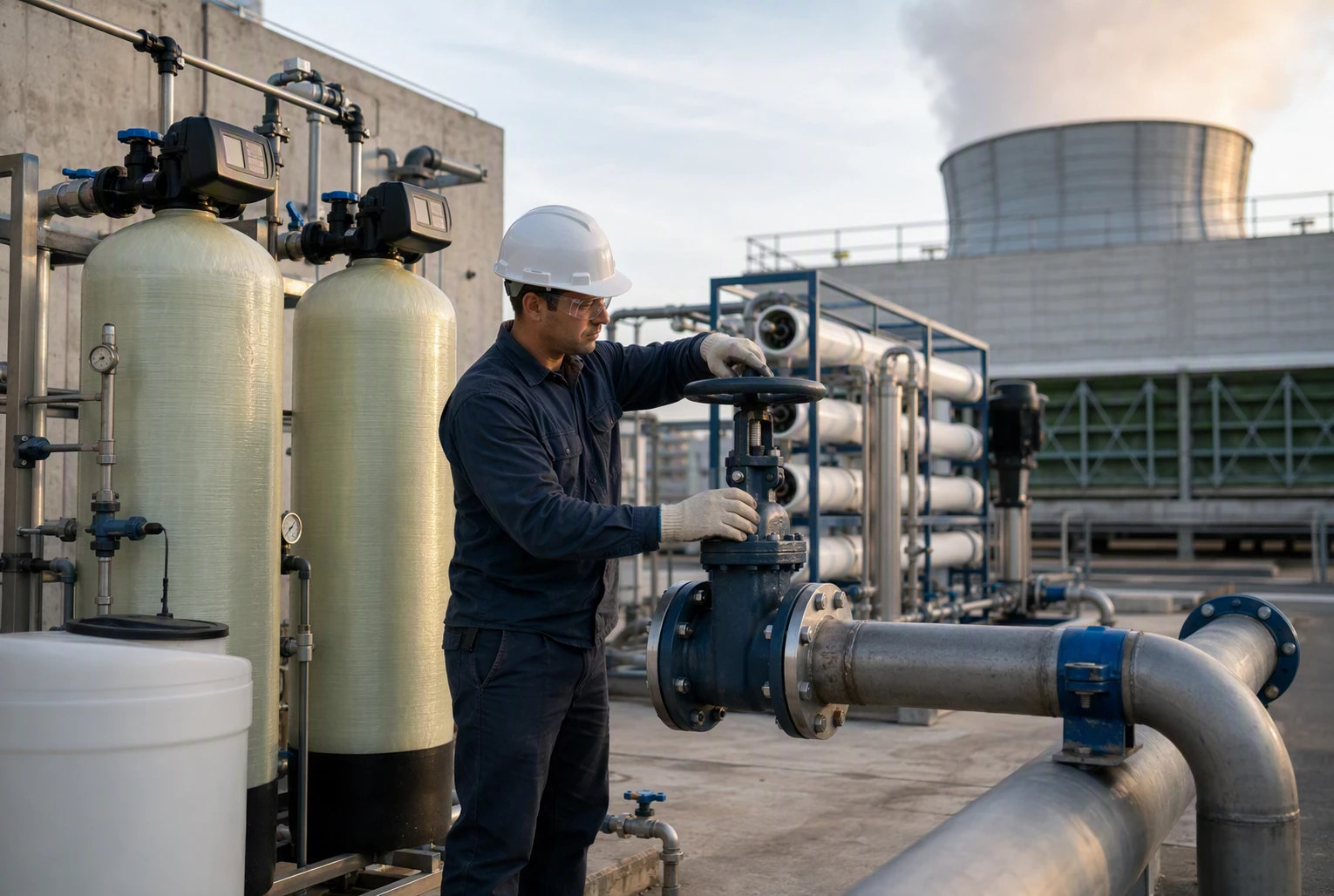
Softening removes hardness before it reaches the tower. Reverse osmosis reduces dissolved solids for difficult make-up water. The Department of Energy notes that softening can support higher cycles, but it needs close corrosion and pH control.
Automated Monitoring and Hybrid Treatment
Use conductivity controls to trigger blowdown at the right limit. Pair pretreatment with scale, corrosion, and biofilm control. DOE says advanced controllers can manage cycles and chemical feed in real time.
Match pretreatment to a full water test, not hardness alone.
Also Read: About Doug Hoffman | Hoffman Soft Water
Which Should You Choose: Filtration, Chemical Treatment, or Both?
Choose Filtration When Solids Are the Main Constraint
Choose filtration when dirt, rust, silt, or process debris drives fouling. Side-stream filters remove suspended solids before they settle in basins and heat exchangers.
The EPA notes that evaporating water concentrates dissolved solids, which can lead to scale and corrosion. EPA cooling tower guidance
Filtration removes particles. It does not control dissolved minerals or microbes.
Choose a Hybrid Program for High-Risk Facilities
Use both for healthcare, food plants, pharma, data centers, and high-load manufacturing. Filtration lowers the solids load. Chemical treatment manages scale, corrosion, and microbial growth.
EPA warns that cooling towers can support Legionella if maintenance falls short. EPA guidance supports verified antimicrobial control.
- Test makeup and tower water regularly.
- Match filters and chemistry to water results.
- Review blowdown, conductivity, and bacteria trends.
Protect your cooling tower with a custom filtration and chemical treatment plan from Hoffman Soft Water. Request a site review today.
Frequently Asked Questions
Q1: What are the top alternatives for cooling tower filtration?
Side-stream filters, hydrocyclones, and basin sweeping remove solids. Water softeners reduce hardness. Chemical programs control scale, corrosion, and microbes. Most towers need a matched combination.
Q2: Can filtration replace cooling tower chemicals?
No. Filtration removes particles but does not prevent corrosion, scale, or biological growth. Keep a controlled chemical program.
Q3: How often should cooling tower filters be serviced?
Inspect filters weekly during heavy load periods. Clean or backwash based on pressure drop, solids load, and manufacturer guidance.
Conclusion
Filtration removes suspended solids; chemical treatment controls dissolved minerals, corrosion, and microbes. Use both based on water tests, because DOE notes that side-stream filtration removes suspended solids but does not remove dissolved particles.