 Hoffman Soft Water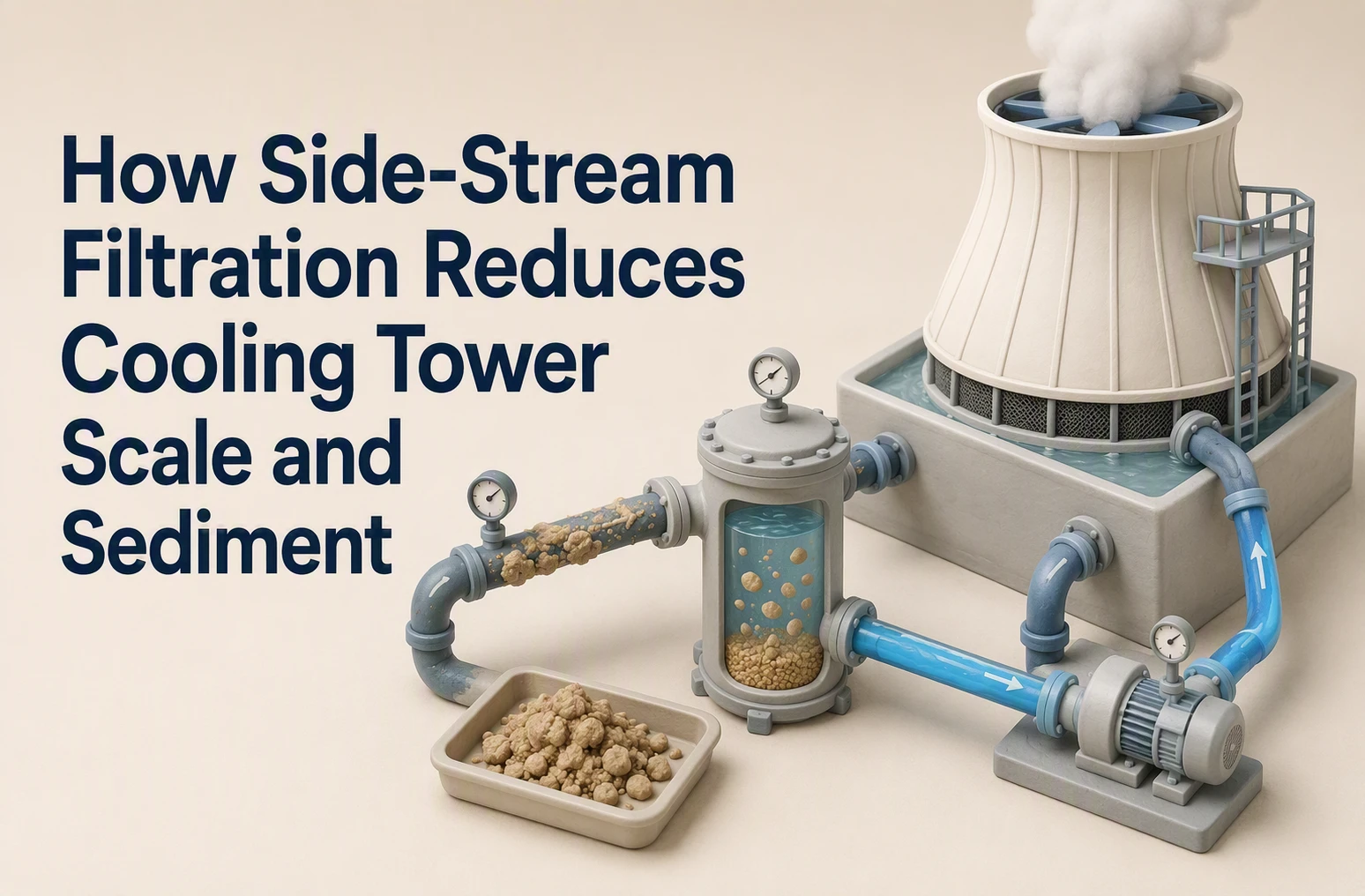
Quick Summary: Side-stream filtration in cooling towers continuously removes airborne dust, rust, and organic debris before they settle as sediment or foul heat-transfer surfaces. This cuts fouling, reduces biofilm growth, and helps chemical treatments work better-though it doesn’t replace them for dissolved hardness. The U.S. Department of Energy emphasizes matching filter types (like disc filters or centrifugal separators) to particle size and load, while monitoring pressure drops and basin conditions to verify results. Properly sized systems typically handle 5–10% of recirculating flow, improving efficiency without eliminating the need for ongoing chemical control.
Airborne dust, rust, organics, and biological debris enter cooling tower water every day. A clear basin can still hold fine solids that foul heat-transfer surfaces and help scale take hold. Tower side stream filtration removes this load before it builds up. This guide explains where tower side stream filtration fits with water treatment, which filter types suit each site, and how to verify results. It draws on practical cooling-water operating principles.
How Side Stream Filtration Controls Scale and Sediment
From Airborne Debris to Basin Sediment
Open towers pull in dust, pollen, leaves, and process dirt. Those solids settle in the basin or keep circulating through pumps and heat exchangers. Tower side stream filtration continuously cleans a portion of recirculating water, removing suspended solids before they build into sediment. The U.S. Department of Energy notes that open cooling towers are prone to dirt, debris, and biological contamination.
Tip: Inspect basin sediment before sizing a filter. Particle type matters as much as total dirt load.
Why Removing Solids Helps Control Scale
Filtration does not remove dissolved hardness minerals. Chemical treatment and blowdown still control that risk. Yet tower side stream filtration removes silt and organics that form insulating deposits and give scale a surface to cling to.
- Less sediment means cleaner heat-transfer surfaces.
- Less debris can also limit biofilm growth.
- Cleaner surfaces make treatment chemistry work more reliably.
DOE explains that reducing suspended solids helps limit fouling and can reduce scale-forming deposits on heat-exchange surfaces. Their technical evaluation also stresses that filtration complements, rather than replaces, chemical control.
Also Read: About Doug Hoffman | Hoffman Soft Water
What Performance and Maintenance Benefits to Expect
Heat Transfer, Reliability, and Cleaning Intervals
Removing silt and debris helps keep heat-transfer surfaces cleaner. That supports steadier cooling, fewer fouled strainers, and longer runs between basin cleanouts. The U.S. Department of Energy notes that side-stream filtration reduces suspended solids that drive fouling and can limit scale-forming deposits on heat exchangers. DOE guidance also notes filters can be serviced while the tower stays online.
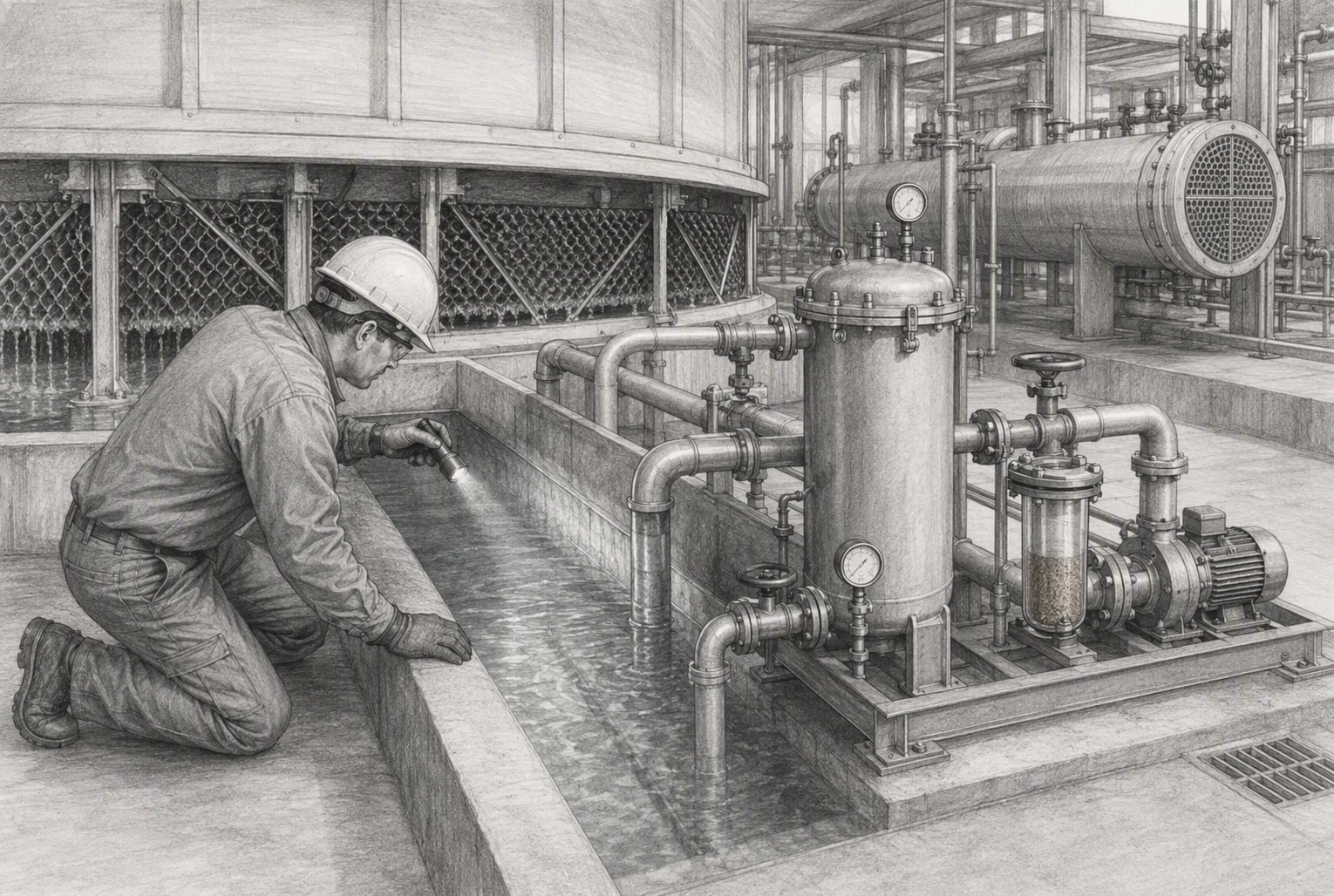
Expect less sediment, not zero maintenance. Track basin condition, filter pressure drop, and exchanger approach temperature.
Water, Chemicals, and Biological Control
Filtration removes suspended matter, so biocides and dispersants have less dirt to manage. It does not remove dissolved minerals or replace a water-treatment program. Better solids control may support higher safe cycles and less blowdown, but chemistry must set the limit. DOE confirms filtration can reduce fouling and biological growth while chemical treatment may still be needed for scale, corrosion, and microbes. See DOE's overview.
Also Read: Blog & Insights | Hoffman Soft Water
Choose the Filtration Technology for the Contaminant Profile
Match the Filter to Particle Size and Density
Test total suspended solids and particle size before you select equipment. Centrifugal separators suit large, heavy grit. Automatic screens protect nonstop operations. Disc filters capture solids and organics. Sand media works best on fine, light particles, according to the U.S. Department of Energy comparison.
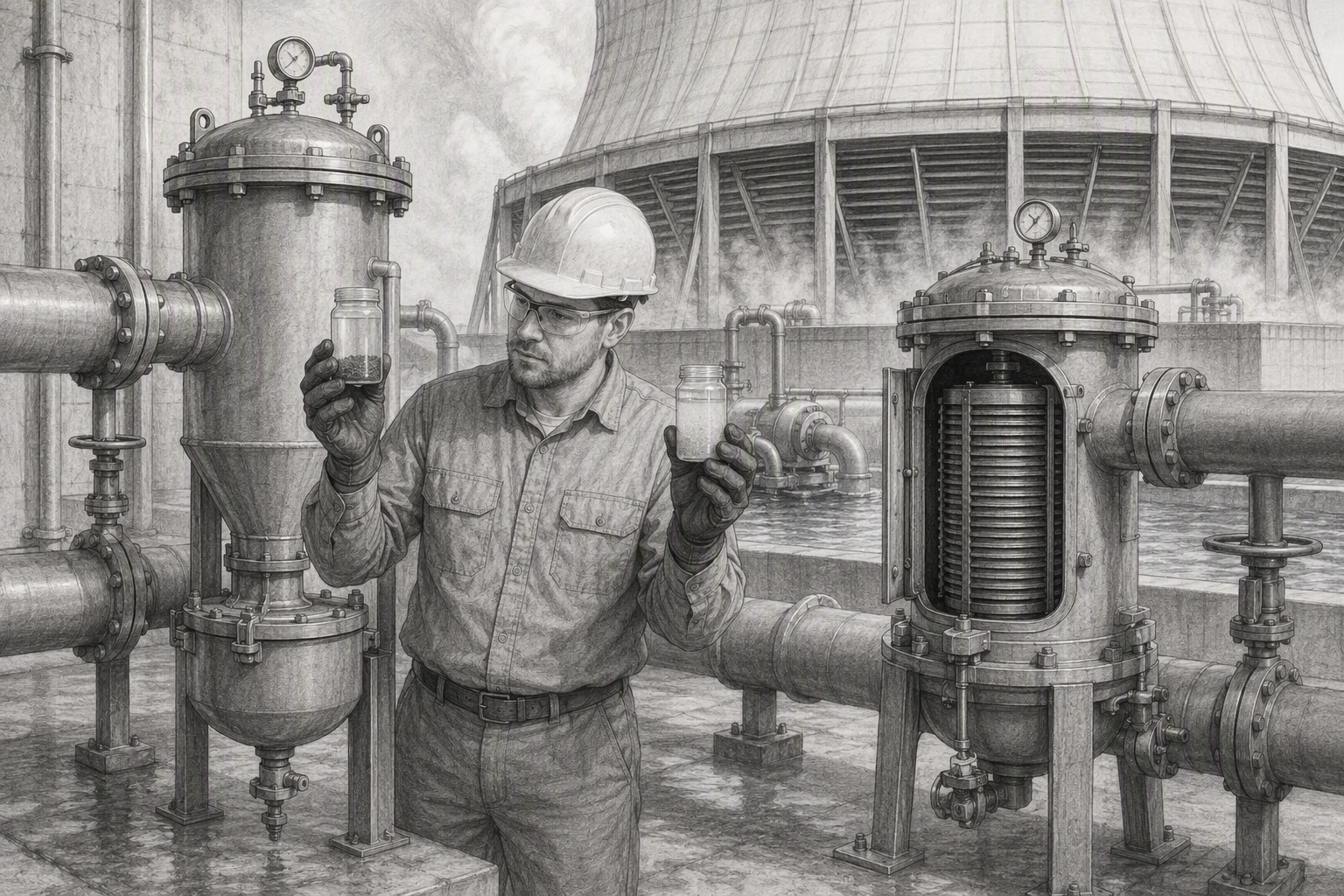
| Contaminant | Best fit |
|---|---|
| Heavy sand and scale chips | Centrifugal separator |
| Fine silt | Sand media |
| Organic debris | Disc filter |
Filtration removes suspended matter, not dissolved hardness minerals. Keep the chemical treatment program in place.
Balance Fine Removal, Footprint, and Operating Cost
Fine media improves water clarity but needs backwash water, floor space, and media service. Screens and disc filters offer a smaller footprint, yet their moving parts or elements need inspection.
- Sample basin water.
- Set a removal target.
- Compare service labor and backwash needs.
Also Read: Water Softening Case Studies | Hoffman Soft Water
Design, Operate, and Verify the System
Establish the Baseline Before Selecting Capacity
Start with water tests and operating data, not a filter size. Record suspended solids, particle size, basin sediment, makeup and blowdown flow, conductivity, and pressure drop. The Department of Energy recommends particle-size and total-suspended-solids tests to match filtration to the tower.
Tip: Sample during peak load and after storms or nearby construction.
Monitor Results and Keep Treatment Integrated
Track filter differential pressure, backwash events, basin condition, conductivity, and heat-transfer trends. Compare them to your baseline each month.
- Keep scale, corrosion, and biocide treatment active.
- Verify makeup-to-blowdown flow ratios against target cycles.
DOE guidance recommends regular meter logs to catch leaks, failed valves, and control drift.
Stop scale and sediment before they cut tower efficiency. Ask Hoffman Soft Water to assess and engineer your side-stream filtration plan.
Frequently Asked Questions
Q1: How does side-stream filtration improve cooling tower performance?
It removes suspended solids before they settle on heat-transfer surfaces. Cleaner water supports better flow, lowers fouling, reduces basin cleaning, and helps chemical treatment control scale more consistently.
Q2: Does side-stream filtration replace cooling tower chemicals?
No. Filtration removes particles, while chemicals manage hardness, corrosion, and microbes. Use both systems together for reliable control.
Q3: How much tower water should a side-stream filter treat?
Many systems filter roughly 5% to 10% of recirculating flow. Your solids load, tower design, and operating hours set the right rate.
Conclusion
Side-stream filtration removes suspended solids that drive fouling and support scale buildup. Match the filter to particle load, then keep chemical control in place for dissolved minerals, as the DOE confirms.